How do you balance pool water chemistry on a weekly service route?
A repeatable routine for testing, dosing, and recording so every pool on your route stays balanced.
Test the same core parameters at every stop: free chlorine, pH, total alkalinity, and stabilizer, plus calcium as needed. Adjust in order, starting with alkalinity, then pH, then sanitizer, so changes do not fight each other. Dose to the pool volume, record readings, and move to the next stop.
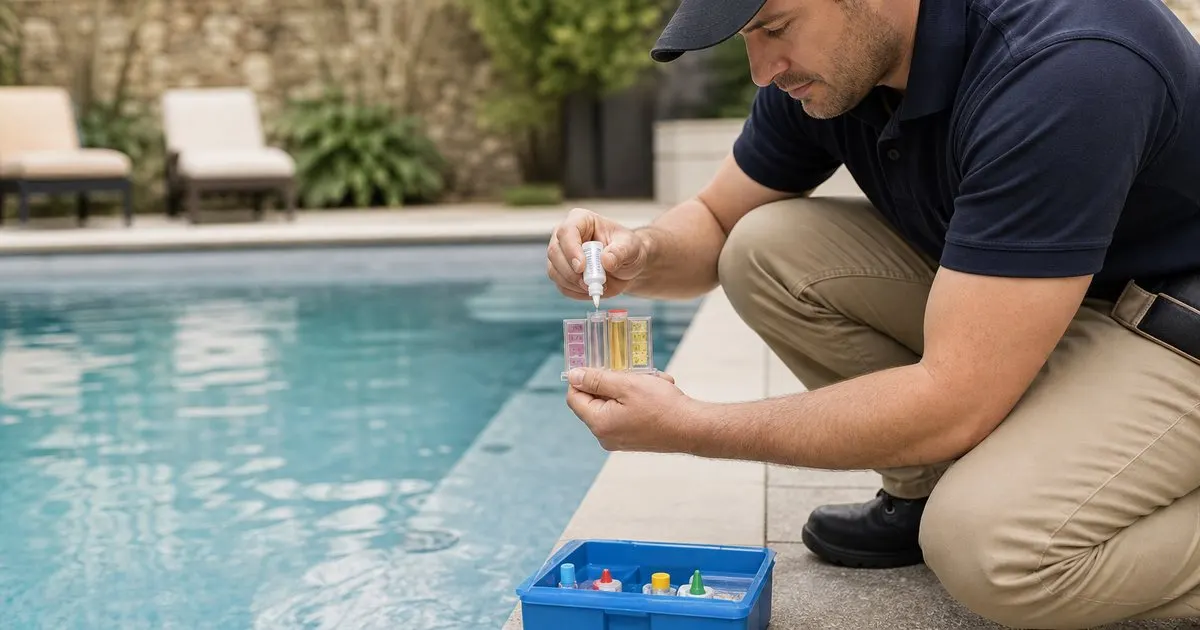
Test in the same order every time
Balanced water is a routine, not a talent. Test the same parameters in the same sequence at every pool: free chlorine, pH, total alkalinity, and cyanuric acid, plus calcium hardness on a longer cycle. A fixed order means you never skip a reading and your entries stay comparable from week to week. Related: Why does free chlorine keep dropping between weekly pool service visits?
The reason order matters is that the parameters interact. Alkalinity buffers pH, and cyanuric acid affects how much of your chlorine is actually working. Reading them together lets you see why a number is off instead of chasing one figure in isolation.
Keep reading: What is the best way to log chemical readings at every pool stop?, Why does free chlorine keep dropping between weekly pool service visits?, When should you shock a residential pool during the peak swim season?. See how PoolTendr helps you pool service route scheduling and chemical logs.
Adjust in the right sequence
Chemistry has an order of operations. Balance total alkalinity first because it stabilizes pH, then adjust pH, then handle sanitizer. Dosing chlorine into water with wild pH wastes product, because chlorine loses effectiveness as pH climbs. Fixing the buffers first makes everything downstream easier.
Dose to a target, not by feel. Knowing the pool's volume lets you calculate how much of each chemical moves the reading to where you want it. Guessing leads to overshooting, which means next week you are correcting your own correction.
Watch the stabilizer trap
Cyanuric acid protects chlorine from the sun, but too much of it locks your chlorine up and the water can go green even with a normal chlorine reading. On a route it is easy to keep adding stabilized chlorine until the stabilizer climbs too high, and then nothing seems to work.
Track cyanuric acid over the season so you catch it creeping up. When it gets too high, the only real fix is diluting with fresh water, and knowing that early saves you from throwing chlorine at a pool that cannot use it. Related: When should you shock a residential pool during the peak swim season?
Record every reading at the pool
The route falls apart when readings live in a tech's head. Log free chlorine, pH, alkalinity, stabilizer, and the dose added at each stop, right there at the pool. That record is how you spot a pool trending the wrong way before it turns green and becomes a callback. Related: Which chemicals should a pool technician carry on a daily service route?
PoolTendr captures the full water panel and the dose in about thirty seconds per stop and files it on the pool, so you carry a balanced route from a routine rather than from memory, and every reading is there to prove the water was right. Related: What is the best way to log chemical readings at every pool stop?
- Test the same parameters in the same order every stop.
- Balance alkalinity, then pH, then sanitizer.
- Track cyanuric acid so it does not lock up your chlorine.
- Log every reading and dose at the pool.

Julien Jimenez
Julien Jimenez is an independent software builder based in Paris. He designs, ships, and operates focused SaaS products for small businesses and independent professionals. Read the full author page.
Frequently asked questions
Why adjust alkalinity before pH?
Total alkalinity buffers pH, so setting it first keeps pH stable and easier to dial in. Correcting pH before alkalinity often means redoing the pH once alkalinity shifts it again.
How often should you test stabilizer on a route?
Cyanuric acid changes slowly, so testing it monthly is usually enough on a stable pool. Check it sooner if chlorine holds poorly despite normal dosing, since low or very high stabilizer can be the cause.
Every Pool, Every Reading, On Route
Pool service route scheduling and chemical logs. PoolTendr is built to help you put this into practice.
Start free trialMore from the PoolTendr blog
What is the best way to log chemical readings at every pool stop?
Why does free chlorine keep dropping between weekly pool service visits?
When should you shock a residential pool during the peak swim season?
Get the PoolTendr playbook
Practical guides on pool service software, straight to your inbox as we publish them. No spam, unsubscribe any time.