Why does pool pH keep climbing back up after every weekly service visit at the same house?
A pool that tests high on pH week after week is usually telling you something about alkalinity, aeration and equipment, not about your dosing. Here is how to find the real driver and stop repeating the same correction.
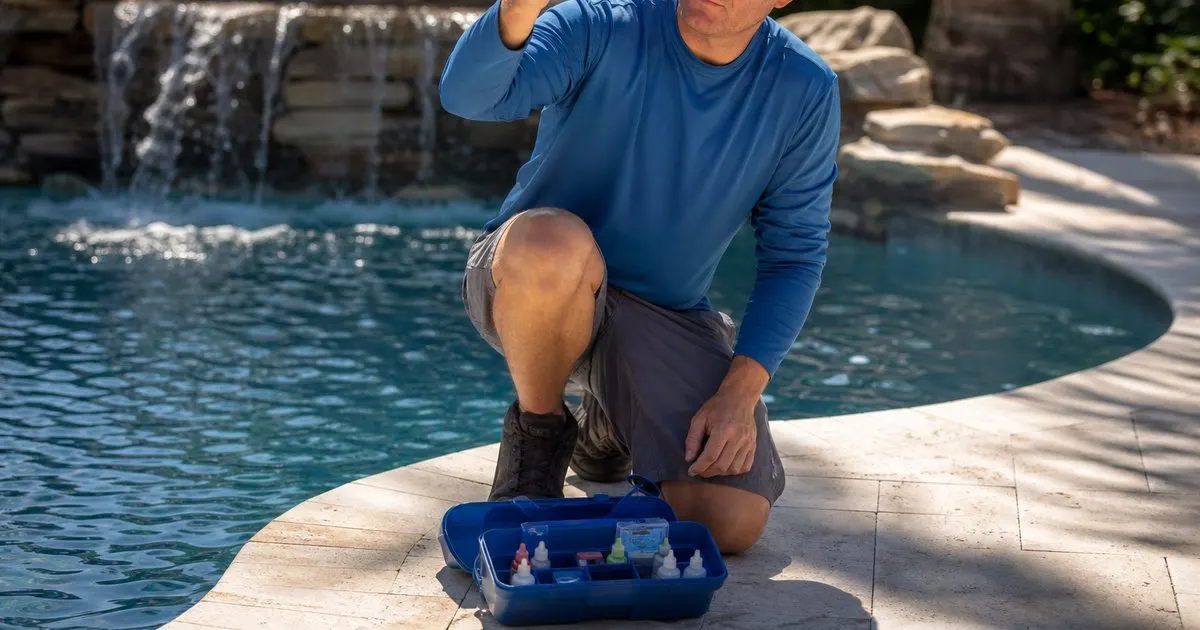
Start by asking what the water does between your visits
When pH reads 7.8 or higher at the same house every week even though you dosed acid at the last stop, the dose is rarely the problem. Water that has just been acidified holds more dissolved carbon dioxide than it wants to, and that gas works its way out of the pool over the following days. Every bit of carbon dioxide that leaves pushes pH back up. Nothing is broken. The pool is doing what the chemistry says it should do, and it will keep doing it until one of the underlying conditions changes. Related: How do you balance pool water chemistry on a weekly service route?
So the first thing to open is not the acid jug, it is the history for that address. Pull the last six to eight visits and read pH and total alkalinity side by side. If pH climbs a similar amount each week while alkalinity barely moves, you are watching normal outgassing on a pool that is over buffered. If alkalinity is creeping up as well, something is adding buffer faster than you remove it, usually the fill water or a high pH chlorine product. Those are two different problems with two different fixes, and guessing between them is what turns a pool into a weekly argument. Related: Why does free chlorine keep dropping between weekly pool service visits?
Keep reading: How do you balance pool water chemistry on a weekly service route?, What is the best way to log chemical readings at every pool stop?, Why does free chlorine keep dropping between weekly pool service visits?. See how PoolTendr helps you pool service route scheduling and chemical logs.
High total alkalinity is why the acid never seems to hold
Total alkalinity is the carbonate reservoir that resists changes in pH. That resistance is useful up to a point, and past it alkalinity behaves like a spring that pulls pH back up every time you push it down. Chlorine pools commonly sit in the 80 to 120 ppm range, and pools running a salt chlorine generator usually want the lower end of that or slightly under it. A pool sitting at 150 ppm or higher will absorb acid week after week and still test high on your next stop, because you are treating the symptom and leaving the buffer intact.
Lowering alkalinity is a process, not a single dose. The standard approach is to add acid until pH sits somewhere around 7.0 to 7.2, then aerate the water so pH climbs back toward range while alkalinity stays roughly where the acid left it, and repeat over several visits until the number lands where you want it. Aeration can come from a spa jet, a waterfall, a return eyeball aimed up at the surface, or a hose left running across the water. Do it in stages that fit inside a normal service stop, and record why the pool was deliberately run low so the next tech does not undo the work. Related: What is the best way to log chemical readings at every pool stop?
Features, salt cells and fresh plaster all push the same direction
Aeration is a pH accelerator. A spillover spa on a timer, a sheer descent waterfall, deck jets, a pressure cleaner churning the surface, or returns aimed upward all strip carbon dioxide faster, so a pool that holds pH for a week with the features off can climb noticeably with them running daily. Salt chlorine generators add their own push, because producing chlorine at the cell also drives pH up as a byproduct. That is why salt pools typically need a standing acid dose and a lower alkalinity target than the same pool would need on tablets. Related: Which chemicals should a pool technician carry on a daily service route?
New surfaces matter too. Fresh plaster and similar cementitious finishes release material into the water while they cure, and it is normal for those pools to run high on pH and calcium for the first several months to a year. Fill water is the quiet one nobody checks. In hard water regions the water coming out of the hose can carry high alkalinity and calcium, so every evaporation cycle and every top off nudges the pool the same way. Test the hose once, write the result in the customer record, and you never have to wonder about it again.
Treat it as a route problem, not a single stop problem
A pool that fights you every week deserves a plan attached to the address rather than a fresh decision at each visit. Log pH, total alkalinity and the exact acid amount at every stop, then read the series instead of the last reading. Most techs settle on a reliable weekly dose within a month of consistent logging, and once that number lives in the customer record, a fill in tech can hit it without relearning the pool. If you rotate routes or take vacations at all, this is the single record that saves the most time and the most acid.
Part of the fix is not chemical at all. Ask the homeowner to shorten the waterfall timer, or move it to the day before your stop instead of the day after. Turn one return eyeball down instead of up. If the pool runs a salt cell, check that output is not set far higher than the pool actually needs, since a cell running flat out all day does more to pH than one trimmed to real demand. Then set expectations honestly. After an alkalinity correction the readings take a few weeks to settle, and a customer who hears that in advance reads the numbers as progress instead of as a problem.
- Weekly pH rebound is usually carbon dioxide leaving the water after an acid dose, not a dosing mistake.
- Check total alkalinity first, because a heavily buffered pool undoes your acid within days.
- Waterfalls, spa spillovers, salt cells, fresh plaster and hard fill water all push pH upward on their own.
- Log pH, alkalinity and acid volume at every stop so the pattern drives the fix instead of the last reading.

Julien Jimenez
Julien Jimenez is an independent software builder based in Paris. He designs, ships, and operates focused SaaS products for small businesses and independent professionals. Read the full author page.
Every Pool, Every Reading, On Route
Pool service route scheduling and chemical logs. PoolTendr is built to help you put this into practice.
Start free trialMore from the PoolTendr blog
How do you balance pool water chemistry on a weekly service route?
What is the best way to log chemical readings at every pool stop?
Why does free chlorine keep dropping between weekly pool service visits?
Get the PoolTendr playbook
Practical guides on pool service software, straight to your inbox as we publish them. No spam, unsubscribe any time.