How do you diagnose a pool pump that keeps losing prime between weekly service visits?
A pump that is dry every Monday points to an air leak, a water level problem, or a failing part. Here is a step-by-step way to find which one on a single stop.
Start with the obvious: water level and baskets
Before hunting for air leaks, rule out starvation. A water level below the middle of the skimmer opening lets the skimmer gulp air, especially when wind pushes water away from it or when a pool loses a little water daily to evaporation and splash-out. In a hot week, a pool can drop an inch or more, and a pump that primed fine on Monday can be sucking air by Thursday. Note the level, fill if needed, and ask whether the autofill (if there is one) is actually working. Related: Which chemicals should a pool technician carry on a daily service route?
Then check the baskets. A skimmer basket packed with leaves or a pump basket collapsing under debris restricts flow enough that the pump cavitates and loses prime. A skimmer weir stuck in the up position does the same. Clear everything, confirm the weir swings freely, and watch the pump run for a minute with the lid on. If the strainer housing fills completely and stays full, starvation was the problem. If bubbles keep streaming into the housing, keep going.
Keep reading: How do you balance pool water chemistry on a weekly service route?, What is the best way to log chemical readings at every pool stop?, Why does free chlorine keep dropping between weekly pool service visits?. See how PoolTendr helps you pool service route scheduling and chemical logs.
Find the suction-side air leak
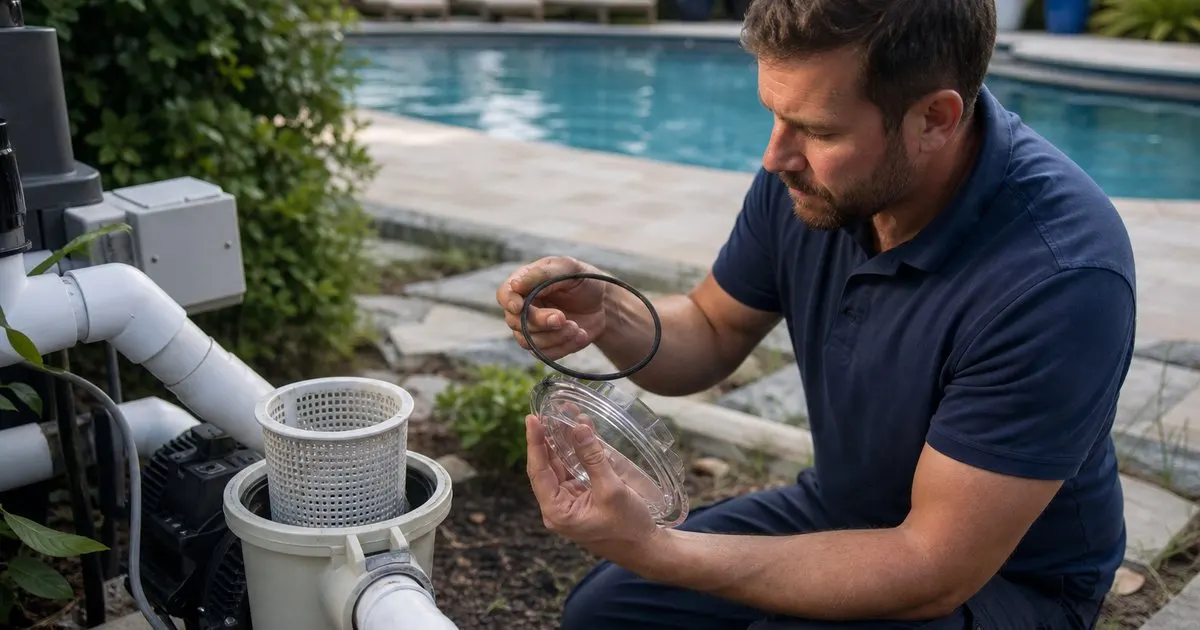
Air in the pump housing while it runs means air is entering somewhere on the suction side, between the skimmer and the pump impeller. The pump lid and its o-ring are the first suspects: a dry, cracked, or stretched o-ring, or a lid not tightened evenly, is by far the most common cause. Clean the o-ring groove, lubricate the o-ring with a silicone-based pool lubricant, and reseat the lid. If the o-ring has flattened or shows cracks, replace it on the spot. Related: Why does free chlorine keep dropping between weekly pool service visits?
Next, check the pump drain plugs, the union on the suction side, and any valve stems in the suction line. With the pump running, a small stream of water from a spray bottle or hose along each joint will change the bubble stream or the pump sound when it hits the leak, because the water momentarily seals it. Shaving cream on a joint that gets drawn inward is an older trick that works too. Underground suction-line leaks are possible but far less common than a fitting on the pad, so exhaust the pad before suspecting the plumbing.
Consider the pump itself
If the pump primes with the lid sealed and every joint dry, but is empty again at the next visit, the water may be draining back after the pump shuts off. A check valve between the skimmer and pump, or on the suction side of an in-floor cleaner system, may be failing. Equipment pads mounted well above the pool's water level rely on that valve to hold prime overnight, and when it fails the pump starts dry every morning until it slowly pulls water back up, wearing the shaft seal each time. Related: What is the best way to log chemical readings at every pool stop?
A worn shaft seal is itself a suction-side leak. Look for drips or a chalky calcium stain under the motor's front end where it meets the wet end. Once the seal is gone, air enters while running and water leaks out while stopped, and the pump will never hold prime reliably. Replacing the seal is a routine repair but not a weekly-stop task; note it, photograph it, and schedule it. A pump that also runs hot or hums without spinning has a motor problem, not a prime problem.
Log it so the pattern shows
The reason weekly loss of prime is hard to diagnose is that you see the pool once a week, for a few minutes. Record what you found each visit: water level, whether the housing was empty on arrival, what you did, and whether it held. Two or three weeks of notes usually reveal the pattern that one visit cannot. A pool that is empty only after windy days points to water level. One that is empty every visit points to a check valve or a seal. Related: How do you balance pool water chemistry on a weekly service route?
Share the pattern with the customer, in plain language, with a photo. A dry pump wears out quickly, and a homeowner who understands that a small o-ring or valve is protecting an expensive motor will usually approve the repair. If your route software keeps equipment notes per pool, put the fix and the part in there so the next tech does not start the diagnosis over from scratch.
- Rule out low water level and clogged baskets before hunting for an air leak.
- The pump lid o-ring is the most common suction-side leak; clean, lubricate, or replace it first.
- A pump that is empty on arrival every week points to a failing check valve or a worn shaft seal.
- Log level, arrival condition, and the fix each visit so the pattern becomes clear over a few weeks.

Julien Jimenez
Julien Jimenez is an independent software builder based in Paris. He designs, ships, and operates focused SaaS products for small businesses and independent professionals. Read the full author page.
Every Pool, Every Reading, On Route
Pool service route scheduling and chemical logs. PoolTendr is built to help you put this into practice.
Start free trialMore from the PoolTendr blog
How do you balance pool water chemistry on a weekly service route?
What is the best way to log chemical readings at every pool stop?
Why does free chlorine keep dropping between weekly pool service visits?
Get the PoolTendr playbook
Practical guides on pool service software, straight to your inbox as we publish them. No spam, unsubscribe any time.