How much chlorine does a green pool need to clear up quickly?
A grounded explanation of shocking a green pool by severity, stabilizer, and why testing beats guessing.
There is no single number, since the dose scales with how green the water is, the pool volume, and the stabilizer level. Light green needs a solid shock, while deep green needs several times more, added until the chlorine holds. Test first, dose to a target, then retest rather than guessing.
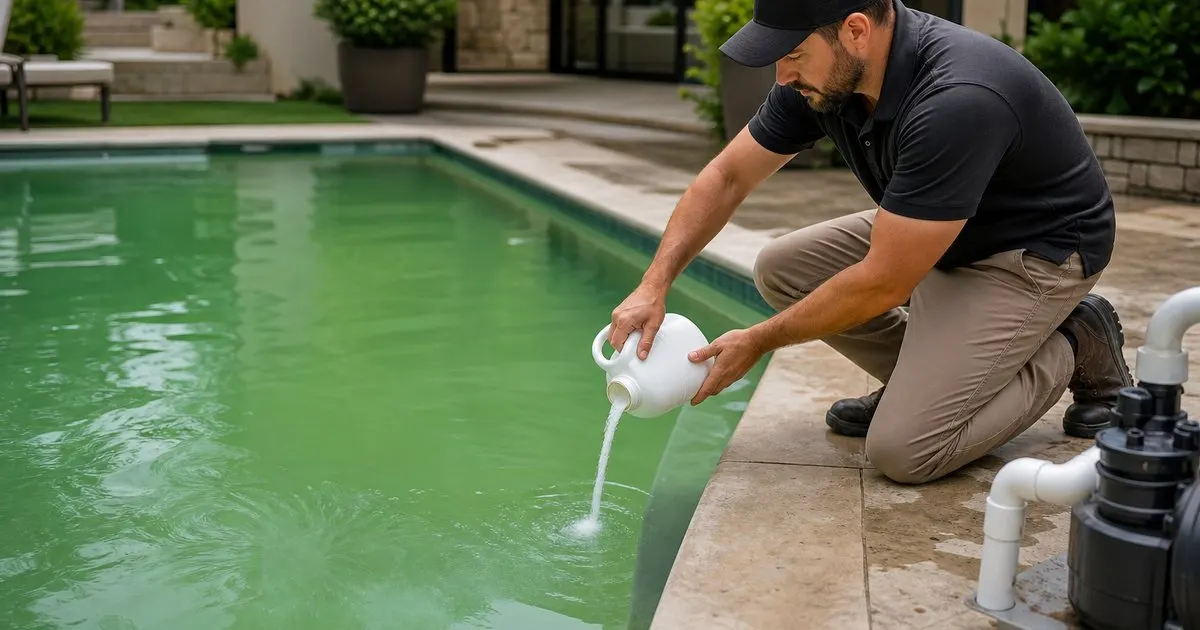
Green means algae, and algae eats chlorine
A green pool is an algae bloom, and clearing it takes far more chlorine than routine sanitizing because the algae consumes chlorine as fast as you add it. A normal dose disappears into the bloom with no effect. You have to add enough to satisfy that demand and still leave a killing residual. Related: Why does free chlorine keep dropping between weekly pool service visits?
How much is enough depends on how bad the bloom is. A faint green tint needs a fraction of what a dark, opaque swamp needs, so the severity of the color is your first gauge of the job ahead.
Keep reading: How do you balance pool water chemistry on a weekly service route?, What is the best way to log chemical readings at every pool stop?, Why does free chlorine keep dropping between weekly pool service visits?. See how PoolTendr helps you pool service route scheduling and chemical logs.
Stabilizer changes the target
The amount of chlorine needed to clear algae rises with the pool's cyanuric acid level, because stabilizer makes chlorine less aggressive. A pool loaded with stabilizer needs a much higher chlorine level to reach an effective sanitizing state than a pool with little stabilizer.
This is why two green pools can need very different doses. Testing the stabilizer tells you what chlorine level you actually have to hit, which is why guessing by pool size alone leads to under-treating.
Filtration and repetition finish the job
Chlorine kills the algae, but the filter removes the dead result, and clearing a green pool is rarely one dose. You shock, run the filter continuously, brush the surfaces, and often shock again until the water turns from green to cloudy blue and finally clear. It is a process over days, not a single pour. Related: How do you balance pool water chemistry on a weekly service route?
Keep the chlorine elevated until the water clears and holds a residual overnight. If chlorine still vanishes by morning, the bloom is not dead yet and the pool needs another round. Related: What is the best way to log chemical readings at every pool stop?
Test, dose to a target, and record it
The reliable path is to test stabilizer and chlorine, dose to the target level the stabilizer demands, and re-test rather than pouring in a guess. Recording what the pool started at and what you added tells you whether the treatment is working across the multi-day cleanup.
PoolTendr logs the pool volume, readings, and each dose you add, so a green-pool recovery becomes a tracked sequence you can see progress on, instead of repeatedly guessing how much more chlorine to throw at it. Related: What service history should you keep for every pool you maintain each season?
- A green pool needs far more chlorine than routine dosing.
- Higher stabilizer raises the chlorine target you must hit.
- Filtering, brushing, and repeat shocks finish the job.
- Test and dose to a target rather than guessing.

Julien Jimenez
Julien Jimenez is an independent software builder based in Paris. He designs, ships, and operates focused SaaS products for small businesses and independent professionals. Read the full author page.
Frequently asked questions
Why does high stabilizer make a green pool harder to clear?
Very high cyanuric acid slows the killing power of chlorine, so you need more of it to reach an effective level. In severe cases, partially draining and refilling to lower stabilizer clears the pool faster than chemical alone.
How long should a green pool take to clear?
With adequate chlorine, filtration, and brushing, many green pools turn cloudy then clear within a few days. Very severe algae, poor circulation, or high stabilizer can extend that timeline.
Every Pool, Every Reading, On Route
Pool service route scheduling and chemical logs. PoolTendr is built to help you put this into practice.
Start free trialMore from the PoolTendr blog
How do you balance pool water chemistry on a weekly service route?
What is the best way to log chemical readings at every pool stop?
Why does free chlorine keep dropping between weekly pool service visits?
Get the PoolTendr playbook
Practical guides on pool service software, straight to your inbox as we publish them. No spam, unsubscribe any time.