Why does cyanuric acid climb so high in pools maintained with chlorine tablets?
Every trichlor tablet adds stabilizer that never leaves on its own. Here is the chemistry, what high CYA does to your chlorine, and how to manage it on a route.
Every tablet is part stabilizer
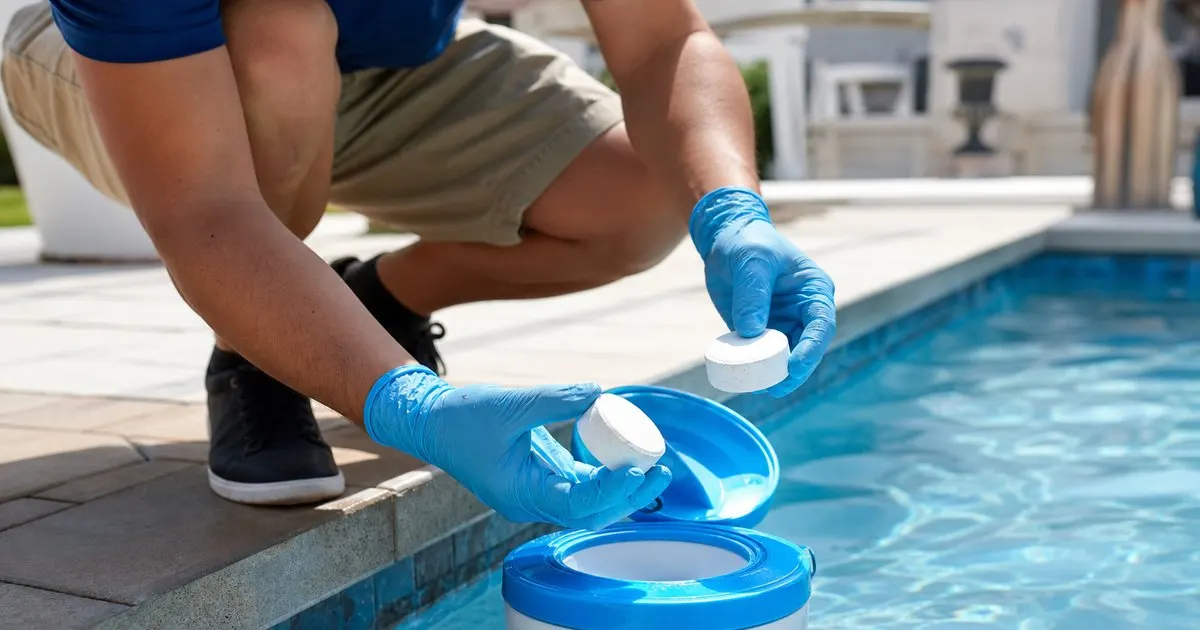
Trichlor tablets are trichloroisocyanuric acid. When one dissolves, it releases chlorine and cyanuric acid together, because the two are chemically bonded in the product. Roughly half of a tablet's weight ends up as cyanuric acid in the water. The chlorine gets consumed by sunlight, swimmers, and organics within days. The cyanuric acid does not. It stays dissolved in the water essentially indefinitely.
On a route, that means a pool fed tablets all season accumulates stabilizer week after week. A pool that starts spring at a healthy CYA level can be well above the range you want by late summer without anyone adding a single bag of stabilizer on purpose. Dichlor granules do the same thing at a somewhat different ratio, so a tech who shocks with dichlor is also adding CYA with every treatment. Related: When should you shock a residential pool during the peak swim season?
Keep reading: How do you balance pool water chemistry on a weekly service route?, What is the best way to log chemical readings at every pool stop?, Why does free chlorine keep dropping between weekly pool service visits?. See how PoolTendr helps you pool service route scheduling and chemical logs.
What high CYA does to your chlorine
Cyanuric acid protects free chlorine from UV loss by binding to it reversibly. That is the whole reason to use it. But the more CYA in the water, the larger the share of free chlorine that is bound at any moment, and bound chlorine kills algae and pathogens far more slowly than unbound hypochlorous acid. Your test kit reports both forms as free chlorine, so a reading that looks fine can hide water that is sanitizing weakly.
The practical rule most experienced techs use is to scale the free chlorine target with the CYA level: more stabilizer means you need a higher free chlorine reading to get the same sanitizing power. Push CYA high enough and the chlorine level required to keep the pool clean becomes impractical to maintain, which is when a pool starts growing algae with what looks like a good chlorine reading. That is what people mean when they say chlorine lock. The chlorine is there; it is just mostly tied up. Related: Why does free chlorine keep dropping between weekly pool service visits?
Test it, track it, and set a ceiling
Test CYA at least monthly on every tablet pool, and more often in hot, dry climates where there is little dilution from rain. The turbidity test (the black dot disappearing in a tube) is coarse but adequate for route work; read it at eye level in good light and remember that it becomes unreliable at very high values, where the sample should be diluted with tap water and the result doubled. Record the number every time so you can see the slope. Related: What is the best way to log chemical readings at every pool stop?
Decide on a ceiling for your company and write it down. When a pool crosses it, the tech should switch that pool off tablets and onto liquid chlorine, and the office should schedule a partial drain and refill. Waiting until the water is green makes the conversation with the customer harder, not easier. A CYA trend line in the pool's log is the best tool you have for having that conversation early, while it is still a maintenance item rather than an emergency.
Bringing it back down on a route
There is no chemical that removes cyanuric acid at route scale in a reliable, cost-effective way. Dilution is the tool: drain a portion of the pool and refill with fresh water, and the CYA drops in proportion to the water replaced. Draining half the pool roughly halves the CYA. Check local water restrictions, confirm the pool's shell and hydrostatic relief are safe for the drain level (fiberglass and vinyl pools have their own limits), and never leave a draining pool unattended. Related: How do you balance pool water chemistry on a weekly service route?
After the refill, rebalance from scratch, because the new water changes alkalinity, calcium, and pH. Then decide how that pool gets its chlorine going forward. Many route companies run tablets in spring, switch to liquid chlorine through the summer once CYA reaches target, and use the tablet feeder only as a backup. That hybrid approach keeps CYA stable, keeps the truck load manageable, and avoids the mid-season drain conversation altogether.
- Trichlor tablets release cyanuric acid with every dose of chlorine, and CYA does not leave the water on its own.
- High CYA binds most of the free chlorine, so a normal reading can hide weak sanitizing.
- Test CYA monthly, log the trend, and set a company ceiling that triggers a change in chlorine source.
- Dilution by partial drain and refill is the only practical route-scale fix.

Julien Jimenez
Julien Jimenez is an independent software builder based in Paris. He designs, ships, and operates focused SaaS products for small businesses and independent professionals. Read the full author page.
Every Pool, Every Reading, On Route
Pool service route scheduling and chemical logs. PoolTendr is built to help you put this into practice.
Start free trialMore from the PoolTendr blog
How do you balance pool water chemistry on a weekly service route?
What is the best way to log chemical readings at every pool stop?
Why does free chlorine keep dropping between weekly pool service visits?
Get the PoolTendr playbook
Practical guides on pool service software, straight to your inbox as we publish them. No spam, unsubscribe any time.