How do you service a saltwater pool with a chlorine generator on a weekly route?
Salt pools still need chlorine management, they just make it differently. Here is what to test, what to adjust, and what to check on the cell every week.
A salt pool is still a chlorine pool
The most common misunderstanding, from homeowners and sometimes from new techs, is that a salt pool has no chlorine. The generator electrolyzes dissolved salt into chlorine continuously while the pump runs, so the pool is sanitized with the same free chlorine you would test in any other pool. Your weekly test list does not shrink: free chlorine, pH, total alkalinity, cyanuric acid, calcium hardness, and now salinity as well. Related: Why does free chlorine keep dropping between weekly pool service visits?
What changes is the delivery. Instead of tablets slowly dissolving, chlorine output depends on the cell's percentage setting, pump run time, water temperature, and salt level. That means a low chlorine reading is a question, not just a dose: is the cell dirty, is the pump schedule too short, is the salt too low, or is the cell simply worn out? Treat the reading as a symptom and look at the system before reaching for the liquid chlorine. Related: How much chlorine does a green pool need to clear up quickly?
Keep reading: How do you balance pool water chemistry on a weekly service route?, What is the best way to log chemical readings at every pool stop?, Why does free chlorine keep dropping between weekly pool service visits?. See how PoolTendr helps you pool service route scheduling and chemical logs.
Manage pH drift and cyanuric acid deliberately
Salt cells push pH upward over time. Electrolysis produces hydrogen gas that aerates the water, and the hydroxide produced alongside the chlorine raises pH directly. Nearly every salt pool on a route will need acid regularly, and many will need it at every visit. Keep total alkalinity toward the lower end of the acceptable range to slow the drift, and expect to log an acid dose most weeks rather than treating it as a surprise. Related: How do you balance pool water chemistry on a weekly service route?
Cyanuric acid needs attention too, but in the opposite direction from tablet pools. A salt pool receives no stabilizer from tablets, so CYA only falls through splash-out and dilution, and techs sometimes let it drop too low. When that happens the generated chlorine burns off in sunlight faster than the cell can replace it. Test CYA monthly, keep it in the range the cell manufacturer recommends (typically higher than for a liquid chlorine pool), and add stabilizer in measured amounts when it slips.
Check the cell, the salt, and the pump schedule
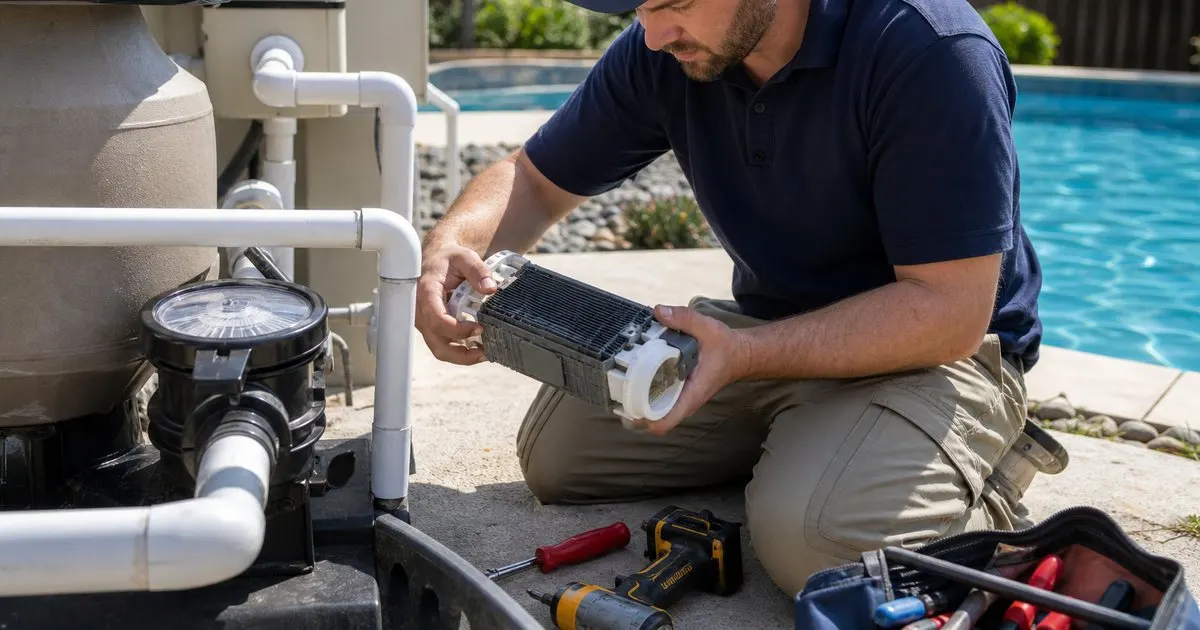
Pull the cell for a visual inspection on a regular cadence, monthly in hard-water areas and at least every few months elsewhere. White crusty deposits on the plates are calcium scale, and they reduce chlorine output. Many cells self-clean by reversing polarity, but heavy scale still needs a manual cleaning with a diluted acid solution following the manufacturer's instructions. Repeated scaling means the water balance needs correction, not just the cell.
Salinity should be tested with your own meter or strips rather than trusting the panel readout, which can drift or misread when the cell is dirty or the water is cold. Low salt after a rainy stretch or a fresh fill is normal; add salt in the amount calculated for that pool's volume and let it dissolve fully before rechecking. Confirm the pump runs long enough, and at a high enough speed, to deliver the cell's rated output. A variable speed pump set too low can starve the cell of flow, and the generator will shut itself off without the homeowner ever noticing.
Log the settings, not just the readings
A salt pool's story is in its settings. Record the cell output percentage, the pump schedule, the salt reading, and any cell cleaning date alongside the chemistry every week. When free chlorine creeps down over a month, that history tells you whether the cell was already at full output (likely worn out) or sitting at a modest percentage (just turn it up). Without it, every low reading becomes a guess. Related: What is the best way to log chemical readings at every pool stop?
This is also the record that saves you when a customer asks why the cell needs replacing. A log showing output climbing to maximum while chlorine stayed marginal, plus documented cleaning dates, makes the recommendation credible instead of sounding like an upsell. Chemical logging software handles this naturally with a field for equipment settings next to the readings, but a consistent note format on paper does the job too.
- Salt pools need the same weekly chemistry tests as any pool, plus a salinity check.
- Expect upward pH drift and plan for regular acid dosing rather than reacting to it.
- Inspect the cell for scale, verify salt with your own meter, and confirm the pump delivers enough flow.
- Logging cell output and pump settings alongside readings turns low chlorine from a guess into a diagnosis.

Julien Jimenez
Julien Jimenez is an independent software builder based in Paris. He designs, ships, and operates focused SaaS products for small businesses and independent professionals. Read the full author page.
Every Pool, Every Reading, On Route
Pool service route scheduling and chemical logs. PoolTendr is built to help you put this into practice.
Start free trialMore from the PoolTendr blog
How do you balance pool water chemistry on a weekly service route?
What is the best way to log chemical readings at every pool stop?
Why does free chlorine keep dropping between weekly pool service visits?
Get the PoolTendr playbook
Practical guides on pool service software, straight to your inbox as we publish them. No spam, unsubscribe any time.